
Lead Capture
LiveForms, missed calls, DMs, and referrals land in one clean intake — captured, scored, and routed into the CRM the moment they arrive.

We replace your disconnected tools — website, booking, CRM, payments, follow-up, and AI — with one branded console you own instead of rent. Built for med spas, home services, lenders, creators, and local operators outgrowing tool clutter.
The problem
Most local businesses are running on rented tools, staff memory, and manual handoffs.
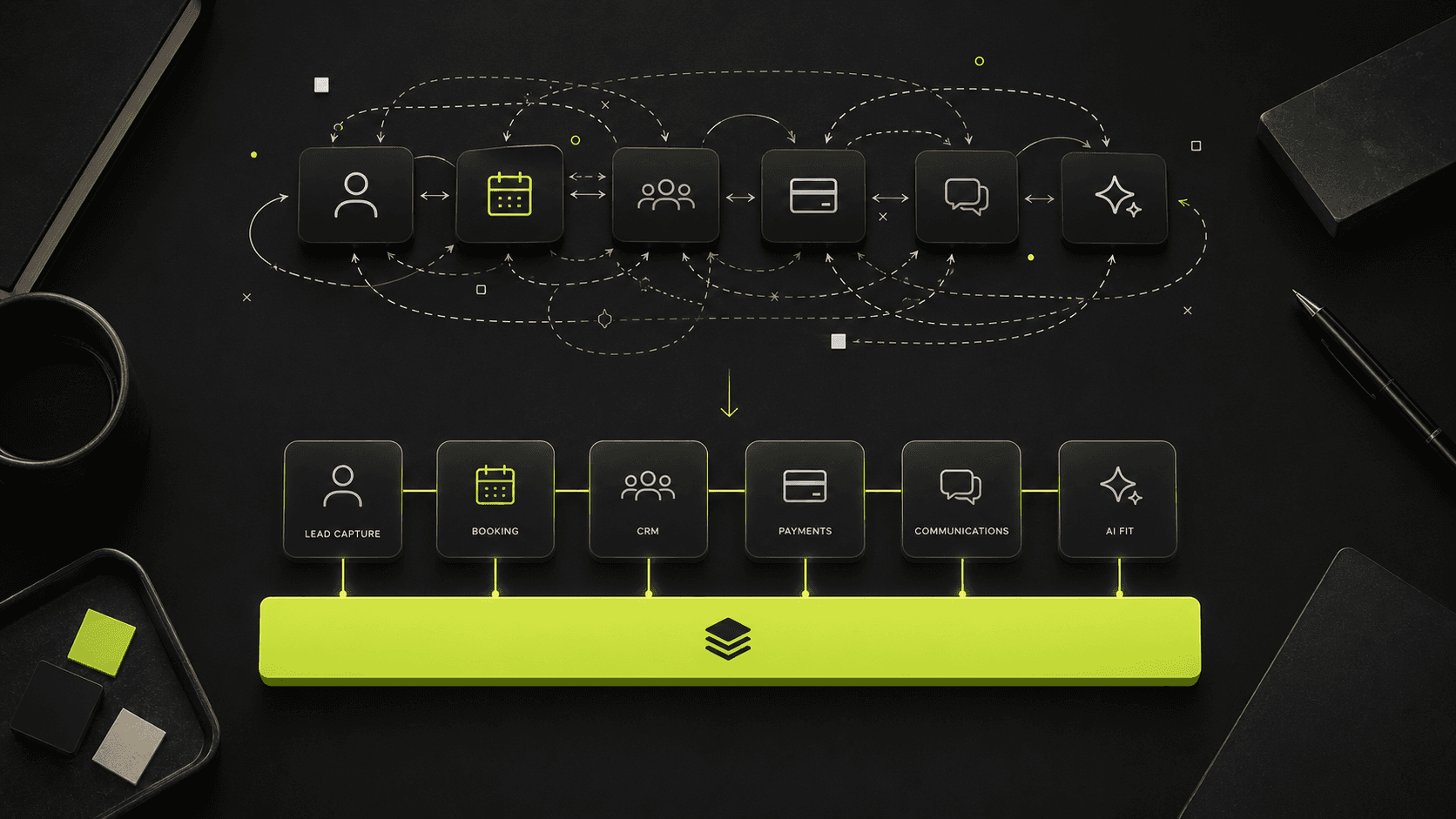
The website is separate from booking. Booking is separate from follow-up. Follow-up is separate from the CRM. The CRM is separate from payments. AI, if it exists at all, is sitting off to the side as a demo instead of being tied to a stable workflow.
YInfra tunes the business end to end and replaces that clutter with a branded operating layer your team can actually use.
The situation
A typical local business runs on six to ten rented tools — website, booking, CRM, forms, email and SMS, payments, reviews. Separate logins, separate bills, and none of them really talk to each other. You pay every month and own none of it.
Separate subscriptions. Monthly, forever. None of it yours.
Rented today. Owned with YInfra.
The building blocks behind premium software have caught up in quality — and they are now ownable, not just rentable. The capability stopped being the expensive part.
YInfra applies those building blocks to your spec, integrates them into one operating layer, and brands it as yours — the same capability as the fewest moving parts, set up the most efficient way we can ship, owned by you instead of rented forever.
How it's built
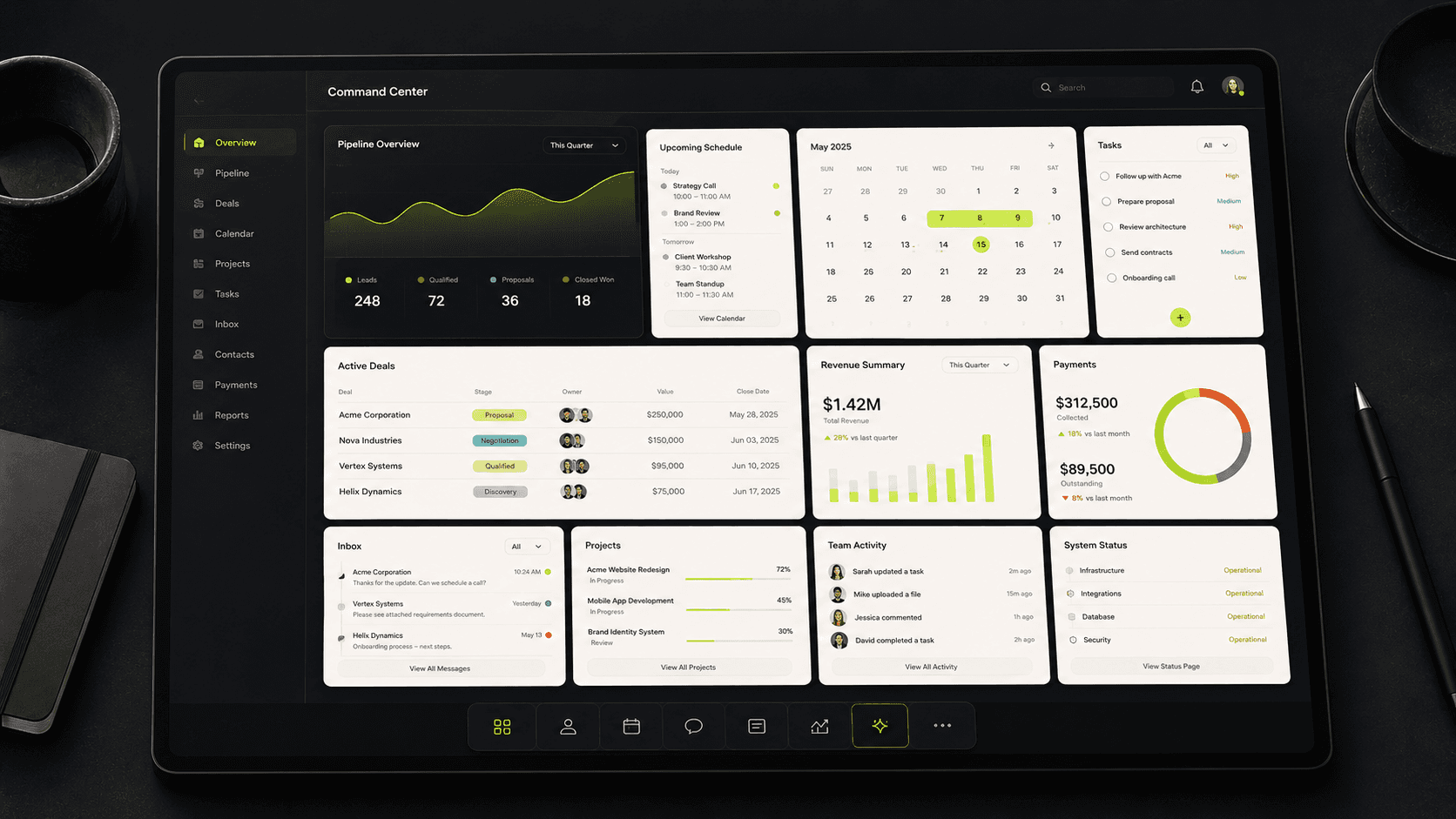
Every YInfra build is composed from a catalog of reusable modules — premium capability as the fewest moving parts, owned by you.
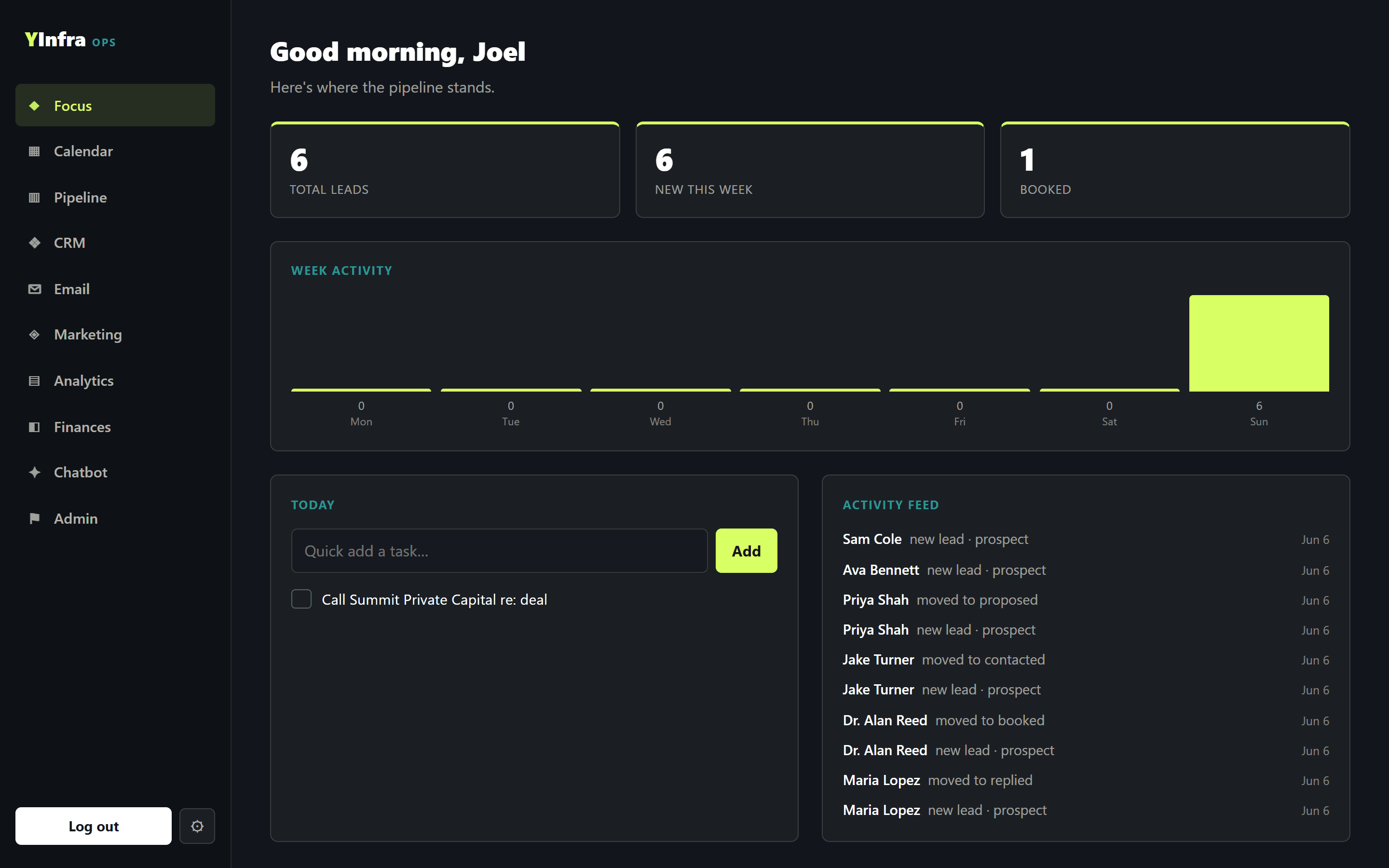
Inside the console
Forms, missed calls, DMs, and referrals land in one clean intake — captured, scored, and routed into the CRM the moment they arrive.
Every lead, client, and active contract carries a stage, a score, and a next step. Site intake flows straight in.
The dashboard you log into: leads, booked work, conversion, and operational drag — charted from your live CRM data once the pipeline is active.
An assistant inside the console for drafting, triage, and quick answers — scoped to assist, with you in the loop.
Customer email composed in-console and wrapped in your branded, mail-client-safe HTML. Connect a mailbox to send.
A built calendar that connects to Cal.com, Google, or Outlook; booked consultations flow into the pipeline.
Payments, invoices, and balance in one finance view — connects to your payment processor with a key.
Social scheduling and ad tracking move into the console next — on the channels you own and the ones you keep.
Team, roles, and payroll run here too — the whole business, not just the front desk.
Cost
A typical local business runs on six to ten rented SaaS tools — website builder, booking, CRM, email and SMS, payments, reviews, forms, and scheduling. Separately billed, never integrated, and none of it truly yours. Average spend: $800–$2,400 per year per tool, compounding monthly, forever.
| Tool | Rented (avg/mo) | With YInfra |
|---|---|---|
| Website builder | $29/mo | Owned — included in your build |
| Online booking | $49/mo | Owned booking layer — connects to your calendar |
| CRM | $99/mo | Owned — live in your console |
| Email & SMS | $79/mo | Owned — branded email, connect-ready |
| Payment processing | 2.9% + 30¢ | Built in — your processor's same rates, zero extra tool |
| Reviews / reputation | $49/mo | Integrated — not a separate subscription |
| Forms | $29/mo | Owned — intake flows into CRM directly |
| Scheduling | $15/mo | Owned — booking layer included |
The rented stack above runs $349/mo — over $4,000/year — for tools that never talk to each other. A YInfra build replaces all of it with one owned operating layer, built to your spec, branded as yours. You pay to build it once; you own it after.
See the full feature-by-feature comparison vs. GoHighLevel and rented stacks
Outcomes
6 separate tools, 6 monthly bills
One owned operating layer
Leads falling through missed calls and DMs
Every inquiry captured, scored, and staged in the CRM
AI sitting off to the side as a demo
AI placed inside a stable workflow with clear review points
Staff copying data between disconnected tools
One handoff from intake to booking to follow-up
Owner visibility from memory and spreadsheets
Dashboard pulling from live CRM data
Renting the brand's online presence from a platform
A branded console on the client's own domain
These are the structural outcomes the operating layer is engineered to produce. First client case studies are publishing soon.
Security AI
Most camera systems show you footage. YInfra's Security AI layer trains computer vision models to the specific workflows that matter to your business — so you get operational signals, not a wall of video to watch.
Per-client computer vision models trained on your footage and your workflows. Not a generic motion detector — a model that knows the difference between a treatment room in use and an idle room, or a retail queue at normal length versus one that is backing up.
Graph Intelligence
A standard CRM stores records. YInfra's Graph Intelligence layer maps the relationships between them — and learns which relationship paths actually convert, refer, and close.
A graph database layer (compatible with a proven graph database) that runs alongside your CRM and maps entity relationships: clients to treatments, deals to brokers, audiences to brands. Where a CRM shows you rows, the graph shows you the web — who connects to whom, and how strong those connections are.
Client → treatment → referral → provider relationships. Find your highest-referring clients, which treatment paths lead to retention, and which providers drive the strongest referral networks. The graph surfaces warmth that a contact list cannot.
Merchant → funder → broker → deal trees. Track deal velocity across the relationship graph — which brokers close fastest with which funders, where deals stall, and which merchant segments convert most reliably. Map the network, not just the pipeline.
Borrower → broker → investor → deal chains. Surface warm paths to capital — which broker introduced the most funded deals, which investors have appetite for which deal profiles, and where in the chain deals tend to fall apart. The graph makes the invisible relationship layer visible.
Audience → brand → deal → content chains. Understand which brand partnerships drove the strongest audience engagement, which deal structures repeat, and which audience segments convert best on specific content types.
Graph data surfaces in the CRM sidebar as a relationship map panel — a live view of connections around the active contact, deal, or account. No separate graph tool or database admin needed.
Who it's for
Not the right fit if…
The first step
The first step is a Business OS Diagnostic.
We look at your public presence, intake, booking, CRM, follow-up, payments, internal workflows, software stack, and AI opportunities. You get a concise teardown of what is leaking time, money, and control, plus a replacement map for the branded operating layer.
YInfra works on selective rolling intake. Qualified owners get a first reply within 24-48 hours, with delivery slots scheduled or waitlisted based on capacity.
FAQ
No. Automation is one layer. YInfra tunes the public presence, customer handoffs, CRM, internal workflows, dashboards, SaaS stack, and AI fit as one operating system.
For managed cloud clients, ownership means portable data, exportable configuration, clear exit rights, and client-specific workflow IP. Literal infrastructure ownership is the self-host deployment case.
No. The operating layer is the product. AI becomes valuable when it is placed inside a stable workflow with clear staff ownership and review boundaries.
OpenClaw is an assistant inside your console. It drafts follow-up messages, summarizes leads, answers questions about your pipeline data, and helps with internal search — always with you in the loop. It does not make decisions or send anything without your review.
The graph database learns relationship patterns from your own data. For a med spa it maps client-treatment-referral networks. For a lending firm it maps merchant-funder-broker-deal trees. For a creator it maps brand-deal and sponsorship relationships. This gives you a view of your business that a flat CRM cannot produce.
A typical local business runs 6 to 10 rented tools at $800 to $2,400 per tool per year. YInfra replaces that clutter with one owned operating layer — investment is scoped in the overhaul proposal after the diagnostic, so the comparison is apples-to-apples against your actual stack.
Not until the compliance posture is explicitly scoped. Healthcare-adjacent work should begin with public presence, intake, and non-PHI operational workflows.
The automation layer runs on open-source MIT-licensed components. Social publishing uses open-source MIT-licensed tooling. Booking integrates with your calendar system. Email is composed with React Email. None of these vendors hold your data or your workflow logic — that stays in your operating layer.
The consultation reviews your current stack, customer journey, manual handoffs, and replacement opportunities. The output is a Business OS Diagnostic and a clear overhaul recommendation.
Yes — GoHighLevel is a good example of the kind of bundled platform YInfra can stand in for, covering the CRM, pipeline, email, booking, automation, and white-label branding surfaces it packages together. But it isn't all-or-nothing: we map your current tools and decide per tool whether to keep, integrate, or replace — you can start on our own infra or work with what you already run. The key difference is ownership: you own the result and your data, not a rented subscription you pay for indefinitely. The compare page covers the feature-by-feature breakdown.
White-label means every surface your team and customers interact with carries your brand — not YInfra's. Your operator console runs on your domain. Emails arrive from your identity, in your colors. Booking confirmation pages, invoices, and client-facing documents are all yours. Your staff logs into a system that looks like it belongs to your business.
Yes — GoHighLevel is a good example of a rented platform. YInfra builds an equivalent layer with owned MIT-licensed components, branded to the client. It's a flexible build-out, not a swap: we map your current tools and decide per tool whether to keep, integrate, or replace — start on our own infra as an easy default, or work with what you already run. The key difference is ownership: you own the result and your data, not a rented subscription you pay for indefinitely.
Available as a scoped addition: computer vision models trained to the client's specific operational workflows. Use cases include med spa room utilization tracking, retail queue monitoring, and premises security. General rollout is on the roadmap; scoped per engagement based on client workflows and infrastructure.
A graph DB maps the relationships in your data — who referred whom, which funder funds which deal type, which treatment leads to which rebooking. For complex relationship businesses (MCA, private lending, med spa), it surfaces patterns that flat tables miss. A standard CRM stores rows; the graph layer shows you the web of connections and which paths actually convert.
A typical local business spends $800–$2,400 per tool per year. With 6–10 tools, that is $4,800–$24,000 in annual SaaS spend — for tools you don't own and can't take with you. A YInfra build replaces that stack with one owned operating layer; the investment is scoped in the overhaul proposal after the diagnostic.
We start with public presence, intake, and non-PHI operational workflows. PHI handling and HIPAA compliance are scoped explicitly and require a separate compliance posture assessment. Healthcare-adjacent clients (med spas, dental, clinics) begin with the operational layer; a HIPAA compliance scope is defined separately based on the specific data handled.
Activepieces (automation — MIT), Postiz (social media management — MIT), Cal.com (booking), React Email, Next.js, and Supabase/Postgres. MIT-licensed where possible — no black-box vendor lock-in. Your workflow logic and data stay in your operating layer, not locked inside a vendor's platform.
Every surface the end-client sees — the console, emails, booking pages, intake forms, and invoices — is branded to THEIR business: their logo, domain, and colors. YInfra is invisible to the end client. The operating layer looks like it was built by and for your business.
The Business OS Diagnostic takes 1–2 weeks to deliver a full teardown and replacement map. The first Quick Win Build (the highest-friction handoff we identify) typically ships within 4–6 weeks of the diagnostic. Intake begins within 24–48 hours of a qualified consultation request on our rolling intake schedule.
Book a Consultation
Tell us about your business and where it is leaking time, money, or control. YInfra works on selective rolling intake: qualified owners get a first reply within 24-48 hours, with delivery slots scheduled or waitlisted based on capacity.
Prefer the full breakdown first? See how the Business OS Diagnostic works.