Activepieces
MITAutomation fabric
No-code workflow automation that connects every console surface and bridges to external tools — self-hosted, no per-task billing.
Replaces Zapier

Our story
YInfra builds white-labeled business operating systems for local companies, replacing tool clutter with owned workflows, branded customer experiences, and AI scoped to the workflows stable enough to support it.
The belief
Most local businesses run on rented tools, staff memory, and manual handoffs. The website is separate from booking, booking from follow-up, follow-up from the CRM. The deeper issue is operational, not cosmetic — and it is fixable by tuning the business end to end.
What we sell
What YInfra sells is ownership and operational control: a branded operating layer the team uses every day instead of a stack of rented SaaS tools doing overlapping jobs. For managed cloud clients, ownership means portable data, exportable configuration, clear exit rights, and client-specific workflow IP; literal infrastructure ownership is the self-host deployment case.
Those owned operating systems get built for local companies — med spas, home services, private lenders, and content creators — and scoping starts with the Business OS Diagnostic.
What we build on
The operating layer is built from open-source, ownable building blocks — an automation layer, social publishing tooling, a scheduling system, and a proven graph database — not black-box SaaS. The diagnostic decides per tool whether to keep, integrate, or replace it: by default we can start on our own infrastructure, but if you already run tools we can integrate with, we work with what you have. Either way the workflow logic and the data are yours, not rented from a vendor who can hold them hostage. YInfra assembles these building blocks to your spec and brands the result as yours.
Automation fabric
No-code workflow automation that connects every console surface and bridges to external tools — self-hosted, no per-task billing.
Replaces Zapier
Social media management
Multi-platform social scheduling inside the operating layer — your content schedule and data never touch a third-party SaaS platform.
Replaces Hootsuite / Buffer
Booking and calendar
Open-source scheduling infrastructure for public booking pages, team calendars, and automated reminders — every booking updates the CRM.
Replaces Calendly
Branded email composition
Component-based email rendering that produces mail-client-safe branded HTML — compose in-console, looks right in Gmail, Outlook, and Apple Mail.
Replaces Mailchimp
Payments and invoicing
Payment processing, invoicing, and subscription billing — an audited, compliance-ready dependency that touches money. Same rates, no extra tool in the stack; integrate the processor you already use.
Replaces Square / PayPal
Database, auth, and storage
PostgreSQL for CRM and pipeline data, Row Level Security for RBAC, Auth for user management — self-hostable, client data stays in the client's instance.
Replaces Airtable / Firebase
Operator console and marketing site
Server-side rendering, API routes, and streaming — the full-stack React framework powering both the console and the marketing site.
Replaces Webflow / Wix
Type-safe application layer
All application code is TypeScript — type safety enforced across the monorepo so capability data, content, and components share the same schemas.
Monorepo package manager
Shared packages — brand tokens, types, utilities — are imported directly across apps without publishing to npm, keeping the build graph clean and dependencies explicit.
Licenses, in plain English
Use it, modify it, self-host it, and rebrand it freely — no copyleft, no strings. The bulk of the stack runs on it.
In the stack: Activepieces, Postiz, React Email, Next.js, pnpm
Strong copyleft: if you modify it and run it as a public network service, those changes get published. It never restricts ownership of your data or configuration.
In the stack: Cal.com (offered dual AGPL-3.0 / MIT)
Permissive like MIT, plus an explicit patent grant for extra legal safety on the foundation layer.
In the stack: Supabase, TypeScript
Proprietary and paid — kept only where renting is genuinely the right call. The account and the data inside it are still yours.
In the stack: Stripe (payment-compliance infrastructure)
Rented vs owned
Automation logic lives in Zapier's cloud, metered per task, forever.
It runs on your self-hosted automation layer — the workflows are yours, with no per-task meter.
Customer records sit in a SaaS vendor's database you can't reach.
They live in your own graph database instance, or a clearly scoped managed one.
Booking, email, and social are three subscriptions that can each raise their price.
They're modules in one operating layer you own outright.
Leaving a SaaS means a lossy export and rebuilding everything elsewhere.
Leaving means you keep portable data, exportable configuration, and the workflow logic.
The vendor sets the roadmap, the limits, and the price.
You set what the operating layer does, because it is built to your spec.
What ownership means
Customer records, pipeline, and history live in your instance — portable and exportable, not locked in a vendor's database.
Automation is self-hosted; the logic is configuration you own and can change, not a black box you rent.
How the operating layer is wired is exportable and version-controlled, not trapped behind a SaaS settings screen.
The console runs on your domain, branded to your business — clients see you, not a reseller's skin on someone else's product.
A scoped build you then run, instead of per-seat or per-task billing that compounds every month, forever.
Clear exit rights: if an engagement ends you leave with the working system and your data, not a support ticket and a CSV.
In the managed cloud model, YInfra runs and maintains the infrastructure on the client's behalf — but with portable data, exportable configuration, clear exit rights, and client-specific workflow IP. In the self-host model, the entire operating layer runs in the client's own infrastructure: their graph database, their automation layer, their data, untouched by any vendor. Either way the operating layer is branded to the business, not rented from a platform.
The proof, for now, is the product
Each surface below is a real screenshot of the operator console, tagged by how far along it is so nothing oversells. See how each engagement captures proof.
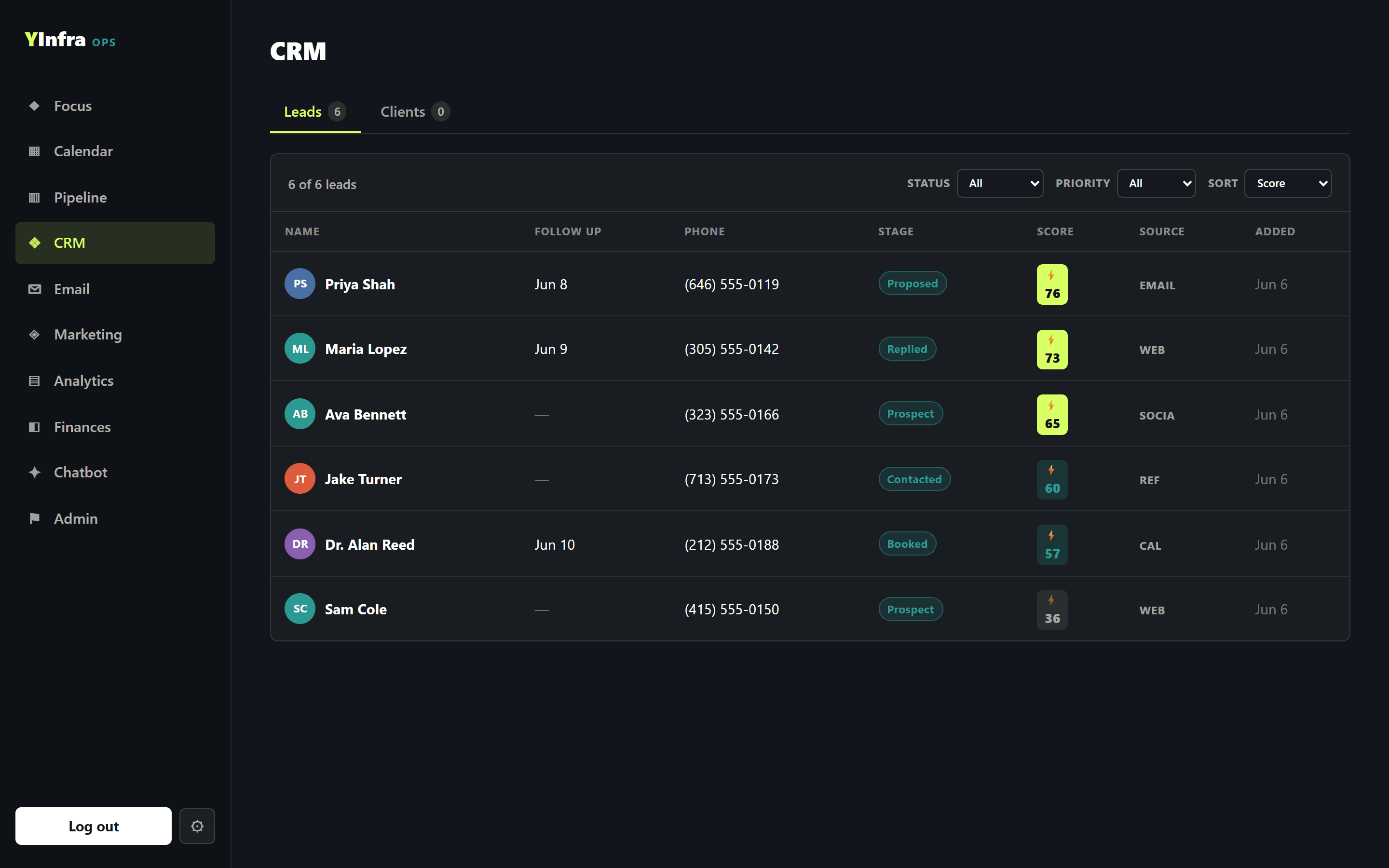
Real leads in the database — intake flows straight into the CRM, scored, staged, and tracked through to active contracts.
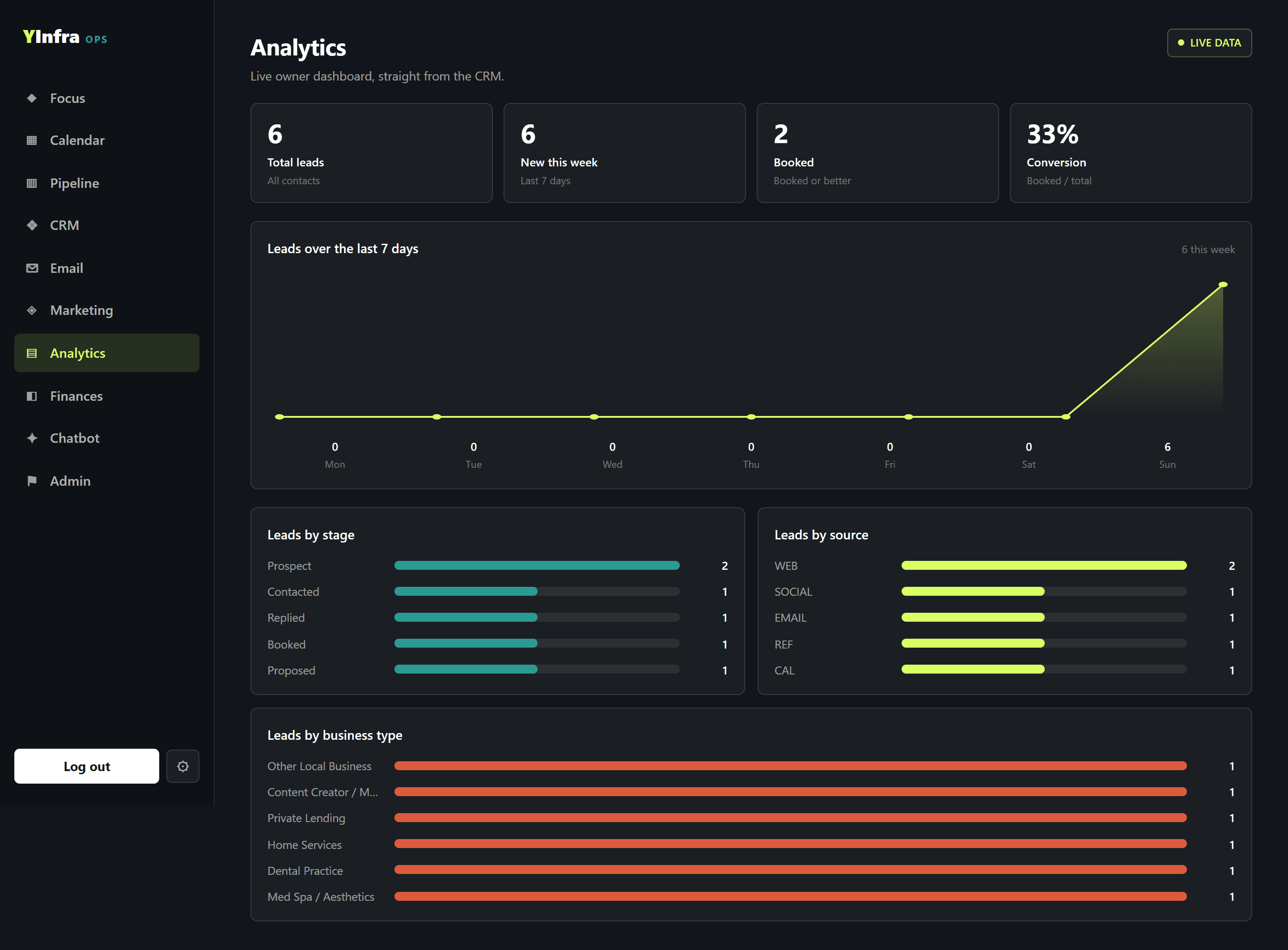
KPIs and trends charted from your CRM data — connects automatically once the pipeline is active.
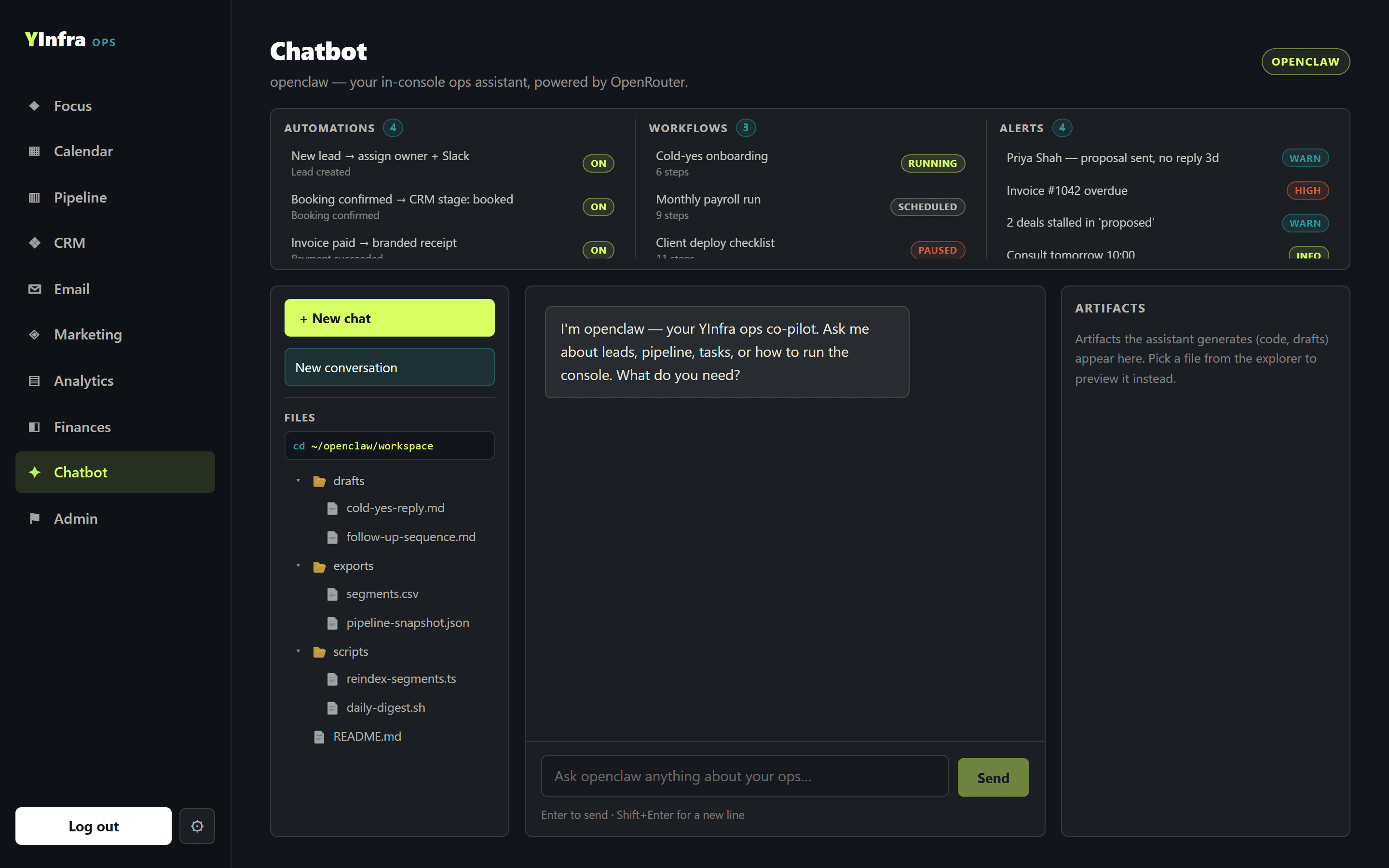
An in-console assistant for drafting and triage — scoped to assist with you in the loop, not an autonomous agent.
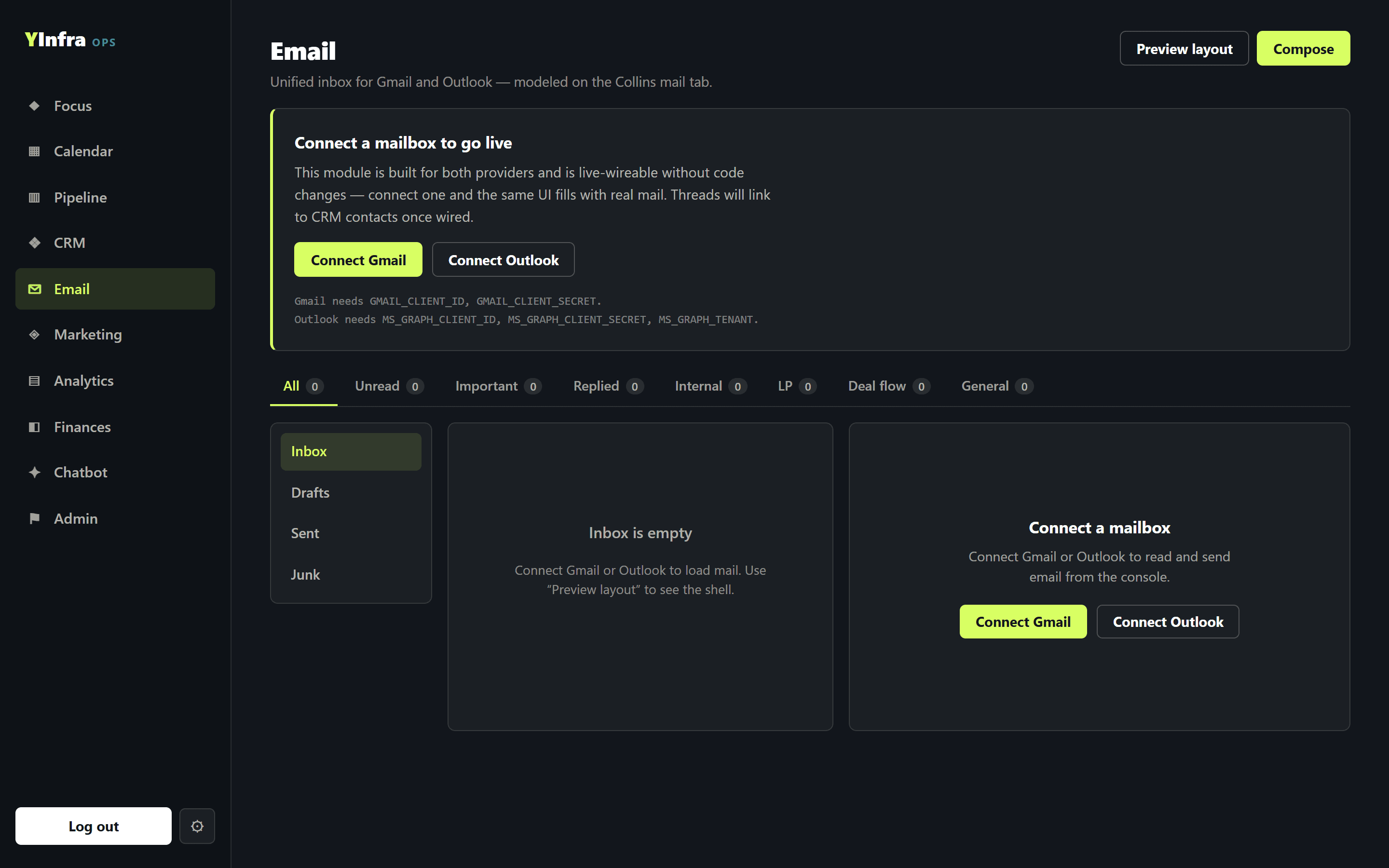
Customer email composed and previewed in your branded, mail-client-safe HTML. Connect a mailbox to send.
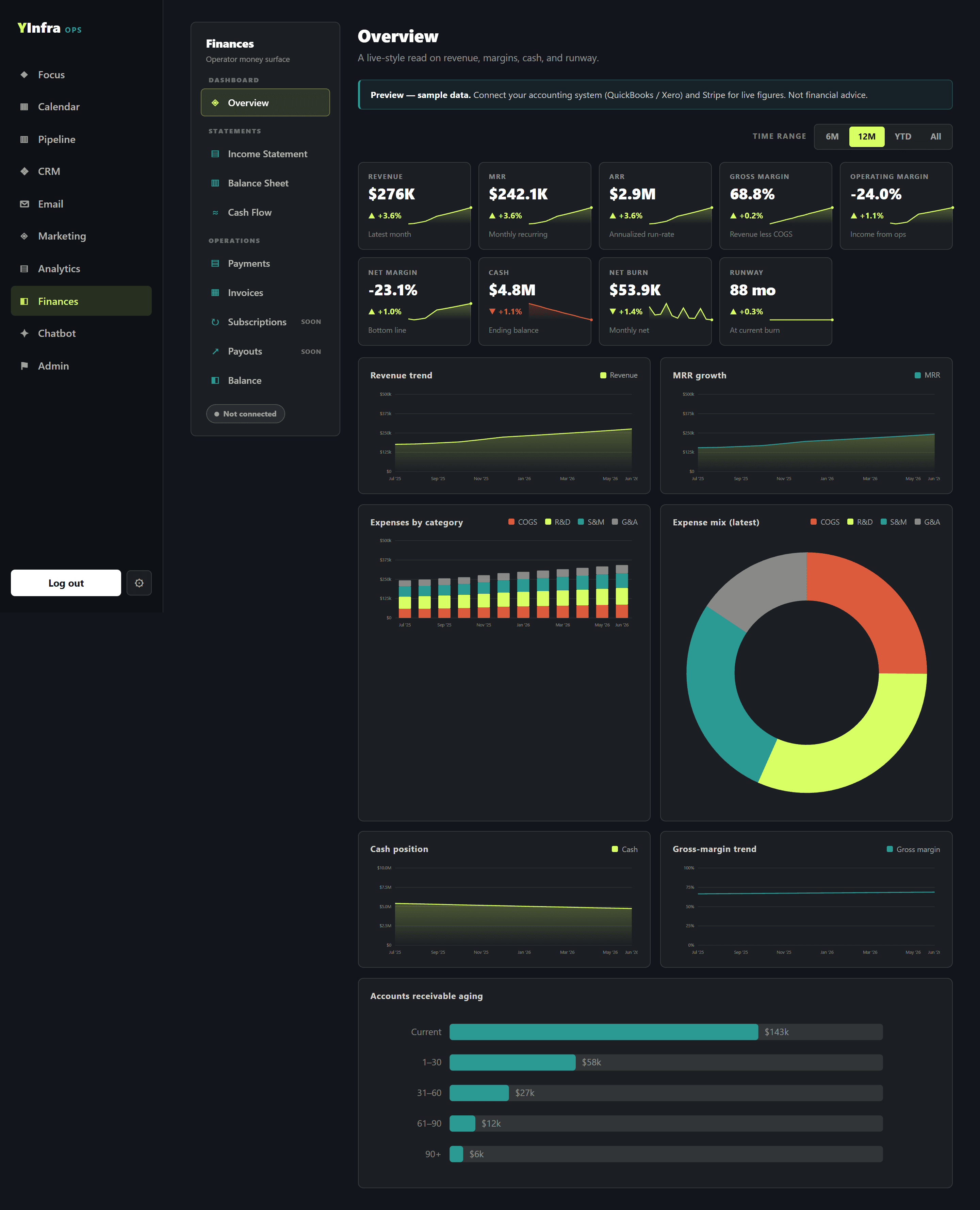
Payments, invoices, and balance in one finance view — ready to connect to your payment processor with a key.
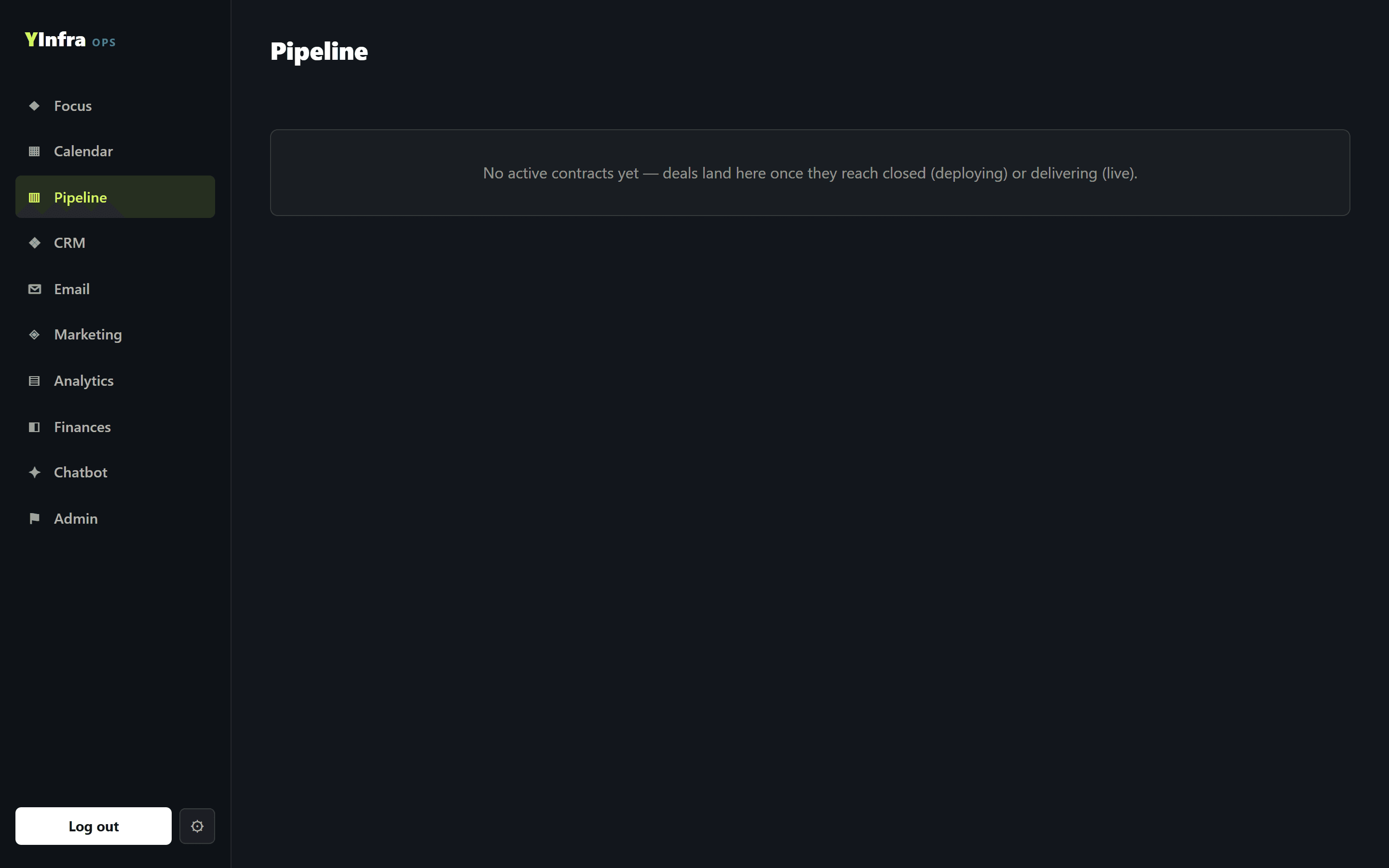
Active contracts derived from pipeline stages — the whole book of work in one view.
What we measure
The customer handoff before the overhaul, set against the same handoff once it runs on owned workflows.
Which rented tools were retired or consolidated into the branded operating layer.
Manual steps removed each week once intake, booking, and follow-up move into one controlled handoff.
Leads that previously fell through forms, missed calls, or DMs and now land in one clean intake flow.
Staff handoffs that depended on memory or copy-paste between disconnected tools, now eliminated.
AI workflows that remain in use after launch — proof the AI was placed inside a stable workflow, not bolted on as a demo.
YInfra is compared feature-by-feature against GoHighLevel, and you can see the cost breakdown against your current rented stack.
Honest, in progress
These are the measures YInfra is built to produce. As a new practice, case studies are being collected with the first clients — this page shows what gets captured, not finished numbers.
Who's behind it
YInfra is the company behind the operating layer — the brand, the product, and the team that builds, deploys, and runs it. One operator accountable for the whole system end to end.
FAQ
YInfra does, for managed-cloud clients — security patches, dependency updates, and version upgrades are part of the engagement. Because every core tool is open-source, the update path is public and inspectable, not gated behind a vendor's release schedule. Self-host clients can run their own update cadence or contract YInfra for maintenance.
You keep your data and your workflow logic. The stack is built from open-source components you can self-host, so nothing is locked behind a YInfra-only platform. Managed-cloud engagements include portable data, exportable configuration, and clear exit rights — you leave with a running system, not a SaaS export that has to be rebuilt.
No. The AGPL's source-sharing obligation applies to distributing modified versions of the software itself, not to running it to operate your own business. If your deployment uses a self-hosted scheduling instance, using it for your bookings does not require you to publish anything. YInfra scopes each deployment so license obligations are met; where a tool is dual-licensed, the appropriate license is selected per engagement.
No. Self-hosting is one of two deployment models, for clients who want the infrastructure fully in their own environment. The default is managed cloud, where YInfra runs and maintains the operating layer on your behalf — with portable data and exit rights, so 'managed' never means 'locked in.'
Not for these tools. The defaults we can start with — the automation layer, social publishing tooling, your scheduling system, a proven database, and a modern web framework — are mature, widely deployed projects, and they're examples of a starting point rather than a fixed set. The capability caught up to premium SaaS years ago — what you gain by switching is ownership and integration, not a downgrade in quality.
Payments are one place where a regulated, audited processor is the right call — so we integrate your preferred payment processor rather than rebuild compliance infrastructure. The workflow logic and customer data around it stay open-source and ownable; only the regulated money-movement layer leans on a commercial processor, and you can keep the one you already use.
These are the measures YInfra is built to produce. As a new practice, case studies are being collected with the first clients — this page shows what gets captured, not finished numbers.
The Business OS Diagnostic takes 1–2 weeks to deliver a full teardown and replacement map. The first Quick Win Build (the highest-friction handoff we identify) typically ships within 4–6 weeks of the diagnostic. Intake begins within 24–48 hours of a qualified consultation request on our rolling intake schedule.
Work with YInfra
Map the current mess, see the owned operating layer, and get a clear next step.
You get a concise teardown of where leads, time, and money are leaking — not a sales call disguised as a form.